Site Forming:
where encounter takes form
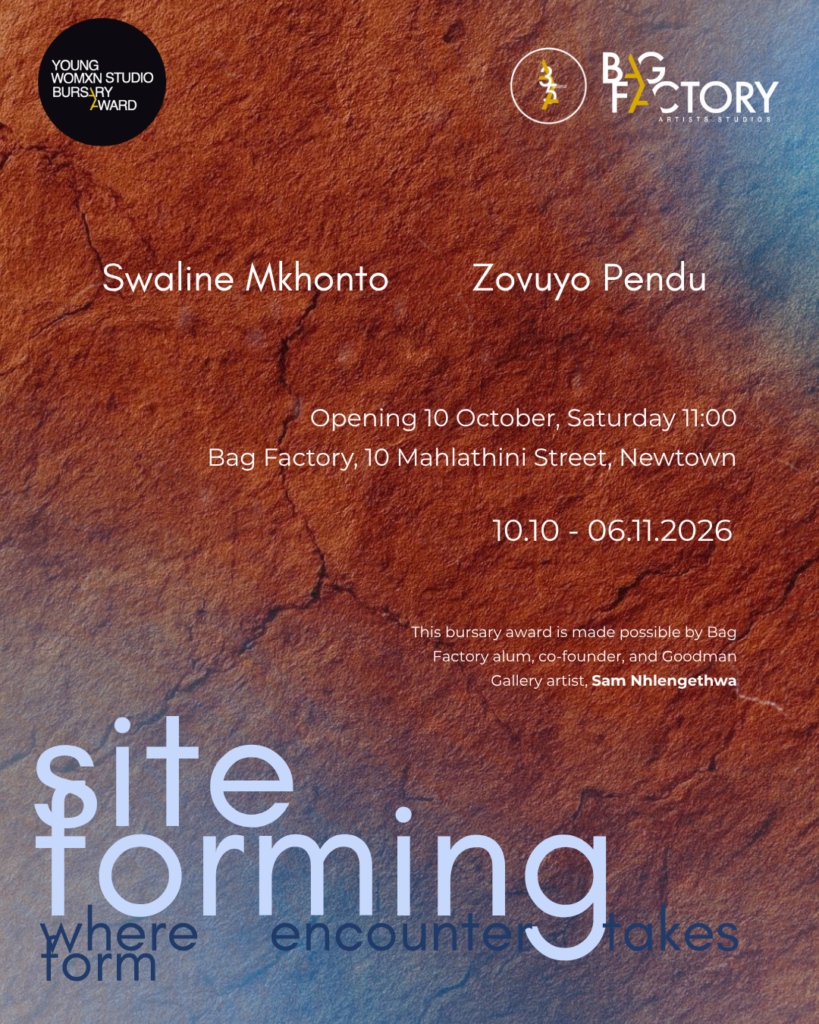
Running 10 October – 6 November 2026
Monday – Friday
10 am – 4pm
Opening Saturday, 10 October 2026, 11 am – 2pm
The project was made possible by founder and funder, Sam Nhlengethwa
A dual exhibition by the 2026 Young Womxn Studio Bursary award recipients,
Swaline Mkhonto and Zovuyo Pendu
To gaze your eyes upon a site is to begin a relationship with that site. This form of [relationship of the] site being gazed upon, and the act of witnessing this site, is an act that perhaps asks us to leave something behind. What is witnessed does not simply remain before us; rather it is altered through our self, sight, and memory, — in turn, we too are altered. The exhibition Site Forming asks us to sit with the ways in which these conditions form, and the language of their visibility. Form here, is not the concern with fixing what has been encountered but rather, it is the constant state of alteration through encounter. Therefore the sites of their forming are not fixed either. Site, when fixed holds and shapes the spaces which surround us, limiting the ways in which one can imagine themselves. When we hold site as a state of encounter and fracture, we begin to acknowledge the landscape, complexity, memories as well as witnessing as a place to imagine otherwise. It becomes a way of giving shape to what remains difficult to settle: a divided self, a dream, an atmosphere, or something that continues to shift while we remain inside it.
“The imagined land/country to which she awaits invitation is therefore , both yearned for and awaited. It is also worked towards” ( Pumla Dineo Gqola ,2010:110)
This exhibition brings together the works of resident artists Swaline Mkhonto and Zovuyo Pendu through different conditions in which they encounter sites becoming visible. Beginning at the site of ‘Nervous Conditions’ [the novel] and Makhololo [Eswatini], Mkhonto’s practice considers what happens when clouds form into fog and refusing one’s sight. The site specific response, engages with the novel not only as a piece of literature but as a device to think through and experience embodied history, site, and being; and Makhololo where the fog makes you sit in them, observing and refusing the sites/ sights before you. In these sites the ‘cloud-like dream’ and I begin to question what would the conduction of a dream begin to do for the possibilities of Black existence. Through sculpture, video, text and collective research [‘Letsema’] , the work moves towards the possibility of dreaming and imagining otherwise. Altering the conditions of sight, cloud and fog become interchangeable with the site of a dream… What happens when dreaming is treated as something one cannot afford? What happens when the conditions surrounding Black existence insist upon the limits of what can be imagined?
The self is never entirely contained within itself; what is encountered in the world crosses inward, becoming felt through the body and altering how the self is perceived. In Pendu’s work, internal states become visible through posture, gesture, physical tension and altered forms where the work holds legacies of contradiction, shame, faith, self-observation and psychological fracture. Positioned in this milieu, a divided consciousness remains internal to one’s own experience. As the politics of surveillance and concealment come to the fore, the psychological distance between the self and its multiple states of being becomes palpable. Here, duplicity exists within the self: experiencing and observing, presenting and recognising, believing and doubting. Recognition then becomes estrangement, as the self encounters itself from a position both intimate and removed. The palpability of these different states of being lingers both spatially and psychologically, where the space is surreal, yet leans closer to an internal psychological landscape. What is external does not remain external; it becomes part of the terrain through which the self comes to recognise itself. The body becomes the threshold through which the world is absorbed, registered and given form.
This exhibition marks the culmination of the Young Womxn Studio Bursary year long residency at Bag Factory Artists’ Studios. Here, the residency becomes a place in which both practices have been given time to develop their questions of materiality. What emerges is not resolution, but exploration: something that can be encountered, witnessed and returned to.
About Swaline
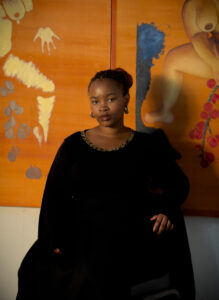
Swaline Mkhonto (b. 2002, Johannesburg) is a South African artist whose interdisciplinary practice spans printmaking, installation, material exploration, and writing. Rooted in process, her work engages land as a site of memory, fragmentation, and transformation. Through materials such as pulp, silk, copper, and perspex, she explores how language and listening can emerge from land itself, treating objects—whether living or inert—as carriers of stories. Mkhonto describes her practice as “a place where fragmentation resides, slowly allowing myself to listen to the quietness in which it speaks.”
About Zovuyo
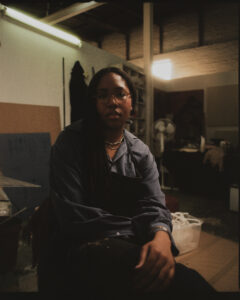
Zovuyo Pendu’s work delves deeper into the psychological negotiations that occur within the self. She uses the body to communicate the emotional conundrums and topical/ongoing perplexing thoughts and emotions through fractured moments of despair, love, morality, resistance, reverence and contradiction. Pendu [b. 2003], is a Johannesburg based multidisciplinary artist, primarily working in painting. She holds a Bachelor of Fine Arts Honours from the University of the Witwatersrand and a participant in the Bag Factory’s Residency programme, Young Women Studio Bursary (YWSB) 2025/26. Her work begins to communicate using her body as the language that speaks truth as it becomes the site of evidence and study.